TikTok Online Assessment 2026: Questions Breakdown and Prep Guide

Think the TikTok OA is just another coding screen you can wing? Think again. ByteDance treats the Online Assessment as a serious gatekeeper — it's the wall between your resume and a real interview loop. And in 2026, they overhauled the entire format.
If you're still prepping based on 2025 guides, you're studying for the wrong test. TikTok switched platforms, dropped multiple-choice entirely, and tightened proctoring. Here's exactly what the 2026 OA looks like, which questions are showing up, and how to pass it without grinding 500 random LeetCode problems.
What Changed in 2026 (and Why It Matters)
TikTok made three significant changes to the OA this year, and each one shifts how you should prepare.
Platform switch: HackerRank → CodeSignal. The entire assessment now runs on CodeSignal. The editor, test runner, and submission flow are different from HackerRank. Spend 30 minutes in CodeSignal's Arcade mode before your OA — free insurance against losing time to UI confusion.
Multiple-choice is gone. The 2025 OA mixed in MCQs with coding problems. That's been completely removed. The 2026 OA is 4 pure coding problems, no shortcuts.
Stricter proctoring. Camera on, screen shared, can't leave the CodeSignal window. Plan your environment — clear desk, stable internet, no second monitors with notes.
The time limit has also shifted. Reports from candidates in early 2026 put it at 70 to 90 minutes for 4 problems (down from the 120-minute window some candidates saw in 2025). That's tighter. You need to solve Q1 and Q2 fast to bank time for the harder back half.
Pro tip: The new CodeSignal format uses a point-weighted scoring system. Harder questions (Q3 and Q4) are worth significantly more points than Q1 and Q2. Don't spend 40 minutes perfecting an easy problem when the real points are in the mediums.
When to Expect the OA for Your Role
Not everyone who applies to TikTok gets an OA. There's a pattern based on your role and experience level, and knowing where you fall saves you from either over-preparing or being caught off guard.
New grads and university hires — expect it 100% of the time. The OA is the first technical filter after your application clears the resume screen. You'll typically receive the invitation within 5-7 days of a recruiter reaching out.
SDE I and SDE II — standard for almost everyone, unless you have a strong internal referral. Even then, don't assume you'll skip it. Most candidates at this level report receiving the OA link within the first week.
Technical interns — within a week of your application being reviewed. TikTok moves fast on intern pipelines, especially for summer cohorts.
Experienced hires (Senior+) — less consistent. Some senior candidates skip straight to a recruiter screen and live technical rounds. Others still get the OA. It depends on your background, the team's hiring urgency, and whether a recruiter advocates for you internally.
Roles That Commonly Require an OA
The OA isn't limited to general SWE roles. TikTok uses it across Software Engineers (all levels), Frontend Engineers, Backend Engineers, Machine Learning Engineers, Data Engineers, and Mobile Engineers. The OA format is the same across these roles — role-specific questions come in the live interview rounds, not the OA itself. Non-engineering roles (product, design, data science) typically don't include this coding OA.
OA Expectations for EMs vs Engineering Leads
Engineering Leads and Staff Engineers may still receive a coding OA, but the emphasis shifts toward system design reasoning, debugging complex scenarios, and multi-threaded logic rather than pure algorithmic puzzles. They're looking for architectural thinking, not whether you can implement Dijkstra's from memory.
Engineering Managers often skip the OA entirely — especially coming from a well-known company. But if your background is management-heavy or you're from a non-FAANG environment, expect a technical screen. They want to verify you can still go deep when needed.
The Correct Way to Prep and Pass the OA Questions
Here's where most candidates waste time. They open LeetCode, sort by "most popular," and grind from problem #1. That's the slowest path to passing. TikTok's OA follows predictable patterns. Your job is to recognize those patterns, not memorize solutions.
1. Time-boxed practice that matches the real format. Set a timer for 75 minutes. Pull up 4 problems — 2 easy, 2 medium. If you can't solve one in 18-20 minutes, move on. Most candidates never practice under real time pressure.
2. Pattern recognition over memorization. TikTok's OA leans heavily on a handful of patterns: dynamic programming, sliding window, graph traversal, greedy algorithms, and (new for 2026) combinatorics. You don't need to solve 500 problems. You need to deeply understand ~8 patterns and recognize which one a problem is testing within the first 2 minutes of reading it.
3. Edge-case discipline. The difference between passing and failing is almost never "I didn't know the algorithm." It's "I missed an edge case." Before submitting: empty input, single element, max constraints, negative numbers, duplicates. Make this automatic.
4. Get comfortable with CodeSignal. If you've only used LeetCode's editor, spend time in CodeSignal's practice environment. The interface differences will cost you minutes if you're unfamiliar.
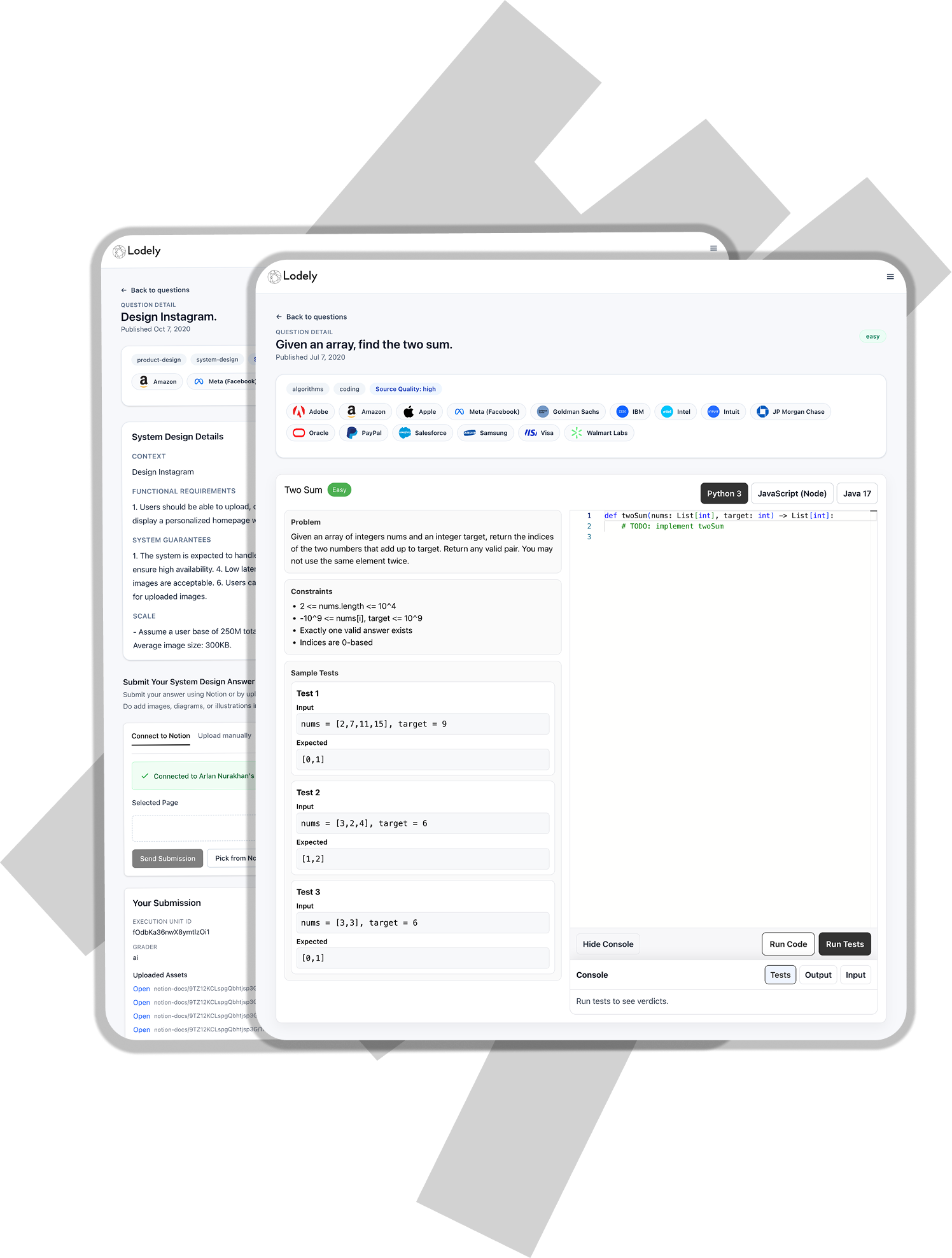
Lodely includes company-specific prep for TikTok and ByteDance that maps directly to the question patterns showing up in 2026 OAs — so you're drilling what actually appears, not guessing from a generic problem bank.
Compiled List of TikTok OA Questions (2026 Edition)
Based on confirmed candidate reports from early 2026, here are the question types and topics actively showing up in TikTok's CodeSignal OA. We've included LeetCode equivalents where a close match exists so you can practice.
- Minimum Operations to Make Array Increasing — Greedy + Array → LeetCode #1827
- Merge Intervals with Constraints — Sorting + Greedy → LeetCode #56
- Unique Paths in Grid with Obstacles — Dynamic Programming → LeetCode #63
- Minimum Swaps to Sort Array — Graph + Cycles → GeeksforGeeks: Minimum Swaps
- Find Peak in 2D Matrix — Binary Search → LeetCode #1901
- Decode Ways II (with Wildcards) — DP + Combinatorics → LeetCode #639
- Maximize Score of Merged Intervals — DP + Binary Search
- Longest Subarray with Sum K — Prefix Sum + HashMap → LeetCode #325
- Remove K Digits to Get Smallest Number — Monotonic Stack → LeetCode #402
- Best Time to Buy and Sell Stock with Cooldown — State Machine DP → LeetCode #309
- Sliding Window Maximum — Deque + Sliding Window → LeetCode #239
- Shortest Substring with All Characters — Two Pointers + HashMap → LeetCode #76
- Reconstruct Itinerary (Flights) — DFS + Lexical Sorting → LeetCode #332
- K Closest Points to Origin — Min-Heap / Priority Queue → LeetCode #973
New patterns emerging in 2026 that weren't common in 2025:
- Server Investment — Greedy + DP (engineering scenario framing)
- Round Robin Load Balancer — Simulation + Queue (real-world system simulation)
- Longest OR Subarray — Bit Manipulation + Sliding Window
- Maximum XOR Suffix — Trie + Bit Manipulation
The trend: TikTok is wrapping questions in engineering scenarios (file systems, server infrastructure, data pipelines) rather than pure abstract puzzles. The underlying algorithms are the same, but you need to translate real-world framing into the pattern it's testing.
1. Minimize Cost of Array Conversion
Type: Dynamic ProgrammingDifficulty: Medium
You're given an array of integers and need to convert it to a strictly increasing sequence using the minimum number of operations, where each operation increments an element by 1.
The naive approach — just making each element one more than the previous — doesn't always minimize total operations. The trick is tracking the relationship between original values and target values using DP. You need to memoize by index and the last assigned value, recognizing that the optimal target for each position depends on what you've already committed to earlier in the array.
What this tests: Can you see past the greedy instinct and recognize when DP gives a better solution? TikTok uses this to filter candidates who default to the first approach that comes to mind without analyzing optimality.
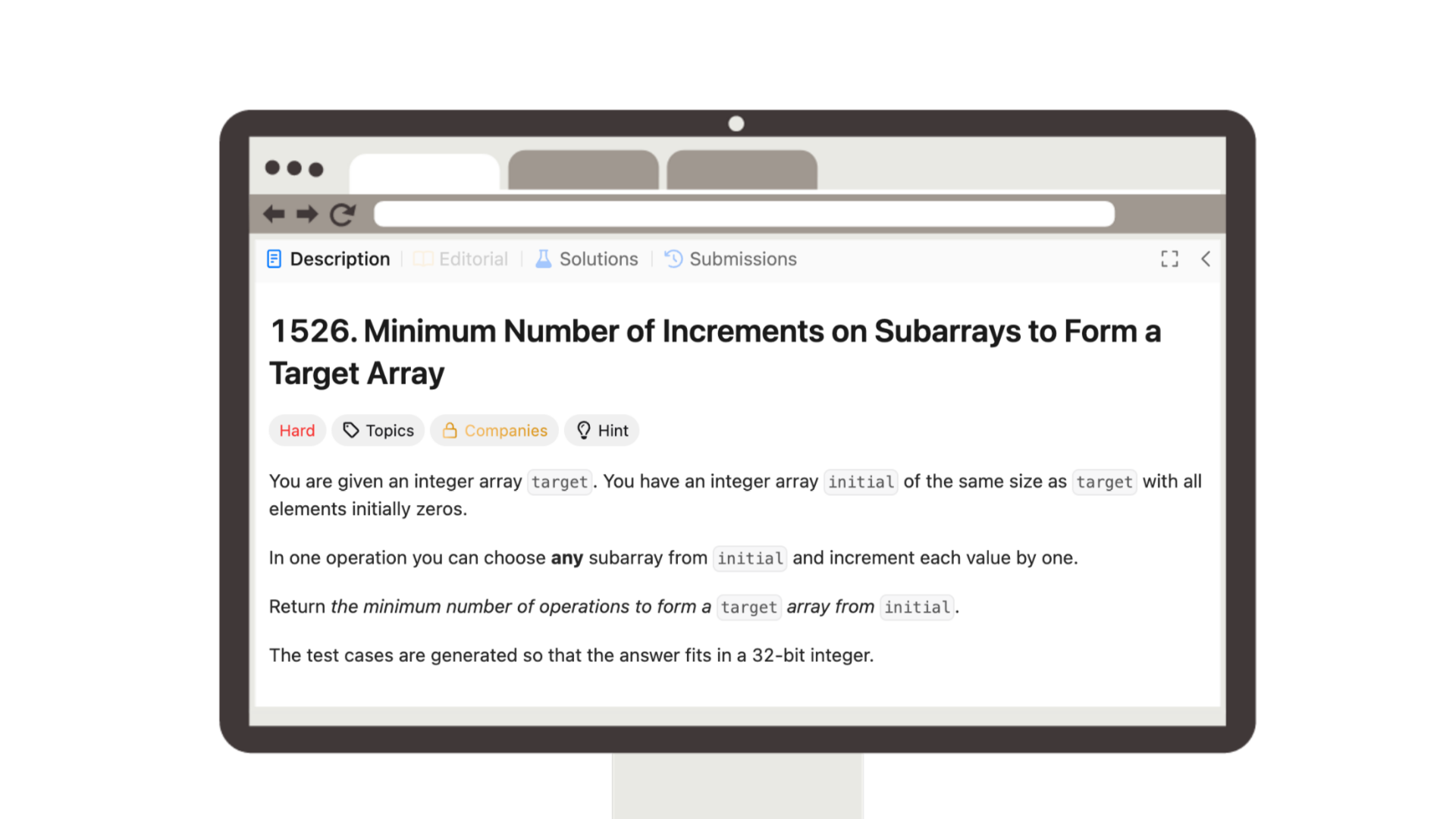
LeetCode cousin: Minimum Number of Increments on Subarrays to Form a Target Array — not identical, but exercises the same DP muscle for array transformation problems.
2. Jump Game with Energy Boosts
Type: Graph + Dynamic ProgrammingDifficulty: Medium
You have a series of platforms, each with an energy cost or energy boost. Starting from position 0 with a given amount of energy, you need to reach the final platform. From each position, you can jump to one of several next positions (not just +1 or +2 — the jump options vary). Find the minimum starting energy required, or determine if it's possible at all.
This is a multi-path graph traversal with resource constraints. Use top-down DP with memoization (tracking position and current energy) or BFS/DFS with pruning. The "energy boost" mechanic is the trap — sometimes the optimal path goes through a costly platform because a later boost compensates.
What this tests: Graph traversal under constraints, and whether you can model a problem with multiple state variables. Candidates who only think in terms of "minimum path" without accounting for the energy dimension get stuck.
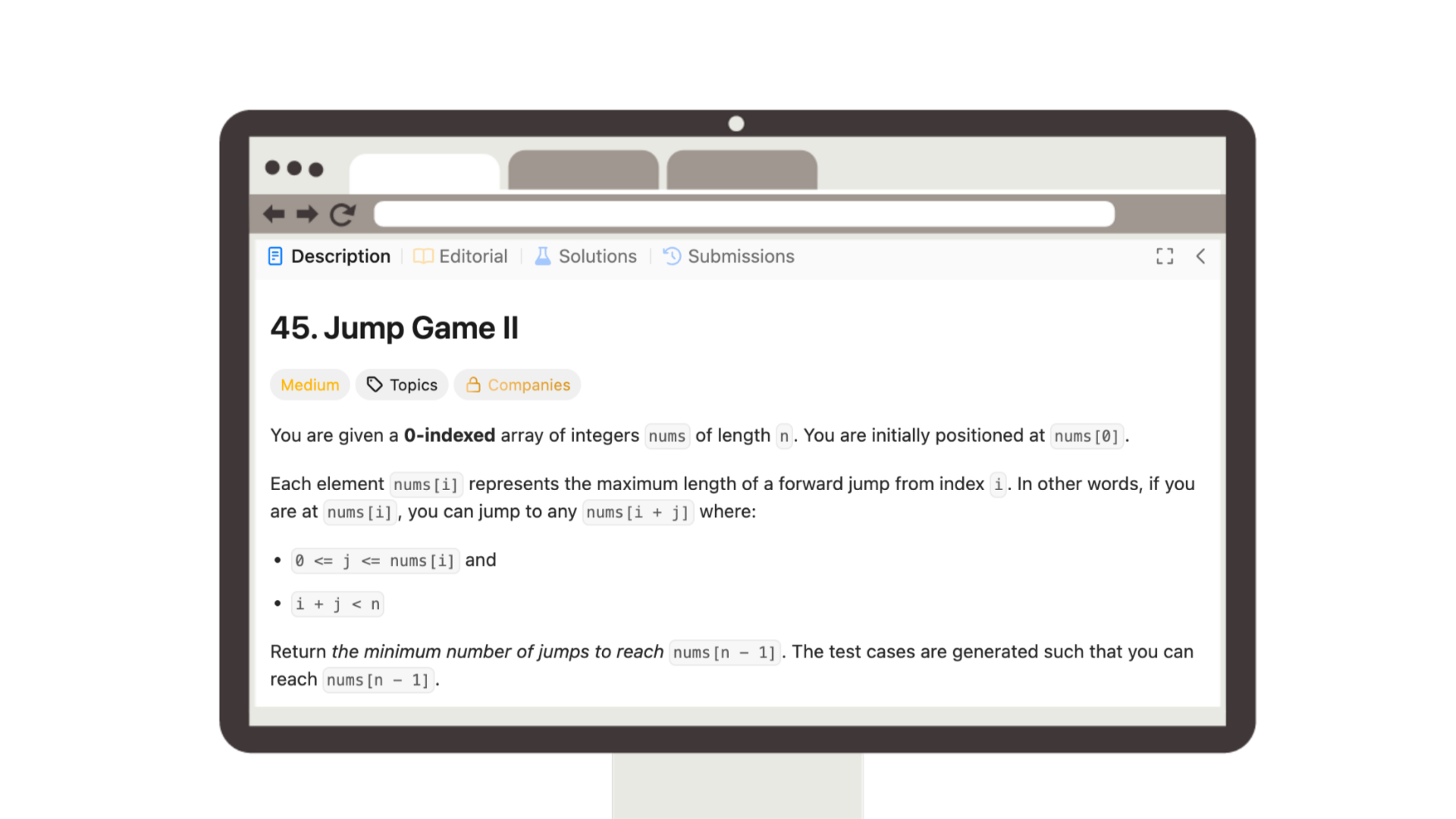
LeetCode cousin: Jump Game II — the classic version tests greedy/BFS. TikTok's variant adds the energy constraint, pushing it into DP territory.
3. Optimize Stock Buy and Sell with Cooldown
Type: State Machine Dynamic ProgrammingDifficulty: Medium
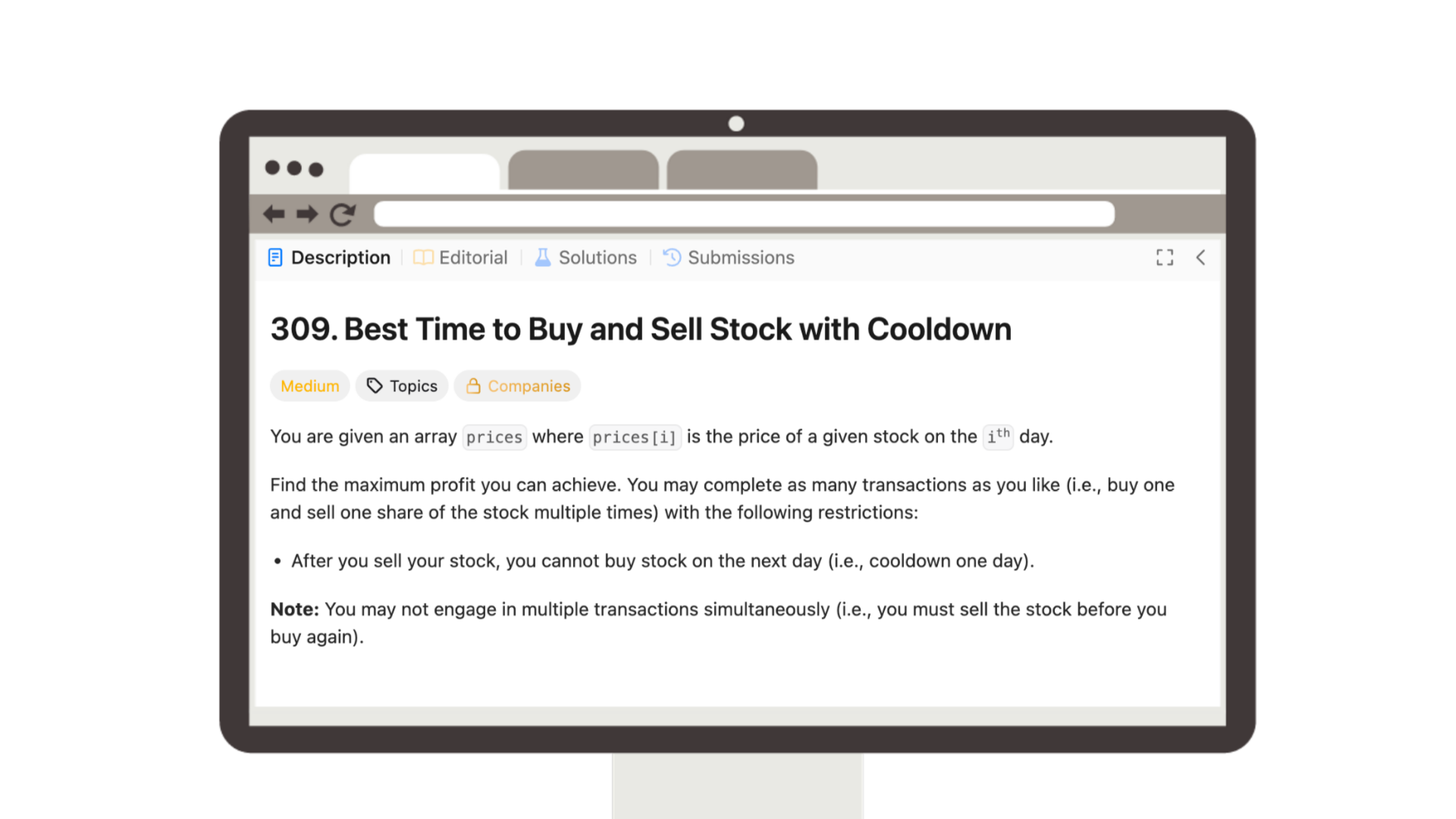
Given an array of stock prices, find the maximum profit where after selling you must wait one day (cooldown) before buying again. You can complete as many transactions as you want.
This is a classic 3-state DP problem. At any given day, you're in one of three states: holding (you own a stock), sold (you just sold and are in cooldown), or rest (you don't own anything and aren't in cooldown). The transitions are:
- holding → holding (do nothing) or sold (sell today)
- sold → rest (cooldown expires)
- rest → rest (do nothing) or holding (buy today)
Build a DP table tracking the maximum profit in each state at each day. The answer is the maximum of sold[n-1] and rest[n-1] (you don't want to end holding a stock).
What this tests: Whether you can decompose a problem into states and transitions — a core skill for DP. The cooldown mechanic is specifically designed to break the "greedy buy low, sell high" instinct.
LeetCode cousin: Best Time to Buy and Sell Stock with Cooldown — this is a direct match. Practice this one until the state transitions feel automatic.
4. Decode Message With Wildcards
Type: DP + Combinatorics
Difficulty: Medium-Hard
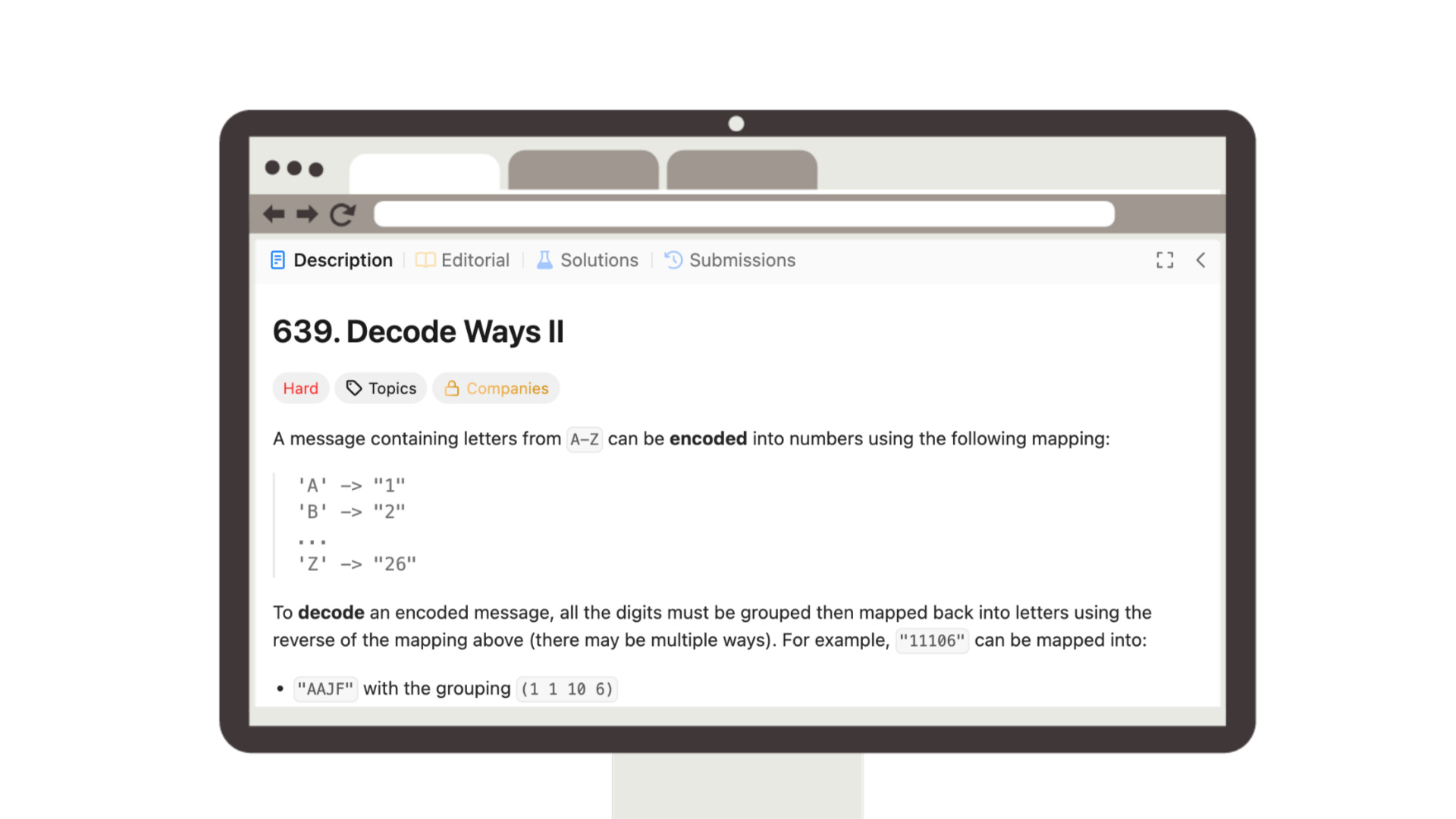
Given a string of digits and * characters (where * represents any digit 1-9), count the number of ways to decode it into letters (A=1, B=2, ..., Z=26).
Without wildcards, this is the standard Decode Ways problem. The * wildcard explodes the complexity because each * can be 1-9, and pairs like 1*, 2*, or ** each have different valid two-digit decodings. Single * alone gives 9 ways; 1* gives 9 two-digit decodings (11-19); 2* gives 6 (21-26); ** combines both single and two-digit possibilities. The DP recurrence tracks valid decodings up to each index, handling all wildcard combinations with modulo 10^9 + 7.
What this tests: Edge-case management and combinatorial reasoning. This problem is a minefield of off-by-one errors and missed wildcard cases. TikTok uses it because it separates candidates who can handle complexity from those who crack under compound conditions.
LeetCode cousin: Decode Ways II — direct match. This is LeetCode Hard for good reason.
What Comes After the OA
Passing the OA gets you into the interview loop, which is where the real evaluation happens. Here's the typical structure:
2-3 live technical interviews (45 minutes each). Harder than the OA — expect LeetCode Medium to Hard. For new grads, rounds 1 and 2 are pure DSA with light behavioral. Round 3 is a hiring manager round with resume deep-dive and light system design.
System design round (experienced hires). TikTok's scale — over a billion users, massive content delivery pipelines — means they want proof you can think in distributed systems.
Behavioral / hiring manager round. Culture fit, communication, cross-cultural collaboration given TikTok's global team structure.
The full loop typically takes 2 months from OA to offer (23 days median on Glassdoor). Lodely covers the entire TikTok interview pipeline — coding, system design, and behavioral — so you're not stitching together prep from five different platforms mid-process.
TikTok/ByteDance Compensation — What You're Playing For
The OA is the first step toward some of the most competitive compensation packages in tech. Here's what ByteDance is paying in 2026, per Levels.fyi (updated March 2026):
- Level 1-2 (entry/junior): $198K median total compensation
- Level 2-1 (mid): ~$320K median TC
- Level 2-2 (senior): $420K median TC
- SWE Manager: $584K–$804K TC
- Level 4-1 (Staff+): up to $1.08M+ TC
That Level 2-2 number puts ByteDance ahead of many FAANG equivalents at the same experience level. The difference between passing and failing the OA is potentially hundreds of thousands in annual comp. An extra 20 hours of focused prep has an absurdly high ROI.
FAQ
Can I use Python, Java, or C++ on the OA?Yes. CodeSignal supports all major languages. Python is the most popular choice for OAs because of its concise syntax and built-in data structures, but use whatever you're fastest in. Speed matters more than language choice.
What happens if I fail the OA?Cooldown period before you can reapply — typically 6 months, sometimes 3 months for a different role. Don't treat it as a practice run.
Is the OA the same for all TikTok roles?The format (4 coding problems on CodeSignal) is consistent, but difficulty can vary by role and level. Data engineering roles may include data-processing questions.
How soon after applying do I get the OA?Typically 5-7 days after a recruiter reviews your application. If you haven't heard back in 2 weeks, your resume may not have passed the screen.
How is this different from a ByteDance OA?Same assessment infrastructure — same company. Whether your role is under "TikTok" or "ByteDance," expect the same format and question pool.
Conclusion
The 2026 TikTok OA is tighter, harder to game, and more focused than previous years. CodeSignal, pure coding, camera on, 70-90 minutes. The topics haven't changed — DP, graphs, sliding window, greedy — but the engineering-scenario framing and stricter time pressure mean you need to be sharper.
Focus on pattern recognition, practice under real time constraints, and get comfortable with CodeSignal before test day. If you want a structured path instead of piecing it together yourself, Lodely's TikTok prep break down exactly what to drill and in what order. The OA is one test — nail it, and you're playing for $200K–$1M+ in total comp.
✉️ Get free faang interview cheat sheet and interview tips weekly
✉️ Get free faang interview cheat sheet and interview tips weekly