CodeSignal GCA: How to Prepare in 2026

The scoring system changed. Again. In 2026, CodeSignal rolled out a new 200-600 scale to replace the old 300-850 range, distributed partial credit more generously, and tightened retake limits to 2 tests per 30 days and 3 per 6 months. If you're job hunting at a tier-1 tech company, this matters: Uber, Instacart, Robinhood, TikTok, Databricks, Zoom, and Brex all use CodeSignal GCA as the front door to engineering interviews. Your GCA score is essentially a credit score for software engineering — and recruiters use it as a hard filter. This guide tells you exactly what changed, why it matters, and how to structure your prep in 2026 to hit 475+.
What Changed in 2026 (and Why It Matters)
The 2026 overhaul compressed the scoring range and shifted incentives. Here's what's different:
New 200-600 scale: Replaces the 300-850 range. Tighter distribution makes the top-to-bottom spread smaller, which means clustering at the middle and harder separation between tiers.
More generous partial credit: CodeSignal loosened partial scoring on imperfect solutions. Previously, a buggy solution might net 10-20% of available points. Now it's more like 30-50% for logic that's mostly there. This is good news if you can't solve Q4 — even a brute-force approach gets you 50-80 extra points instead of nearly nothing.
Retake policy tightened: Maximum 2 tests per rolling 30-day window, 3 per rolling 6-month window. This pressures first-time performance; you can't spam retakes anymore.
Skill-level scoring: CodeSignal now tags your performance by area (arrays, graphs, dynamic programming) and labels you as Expert (≥1.0), Advanced (0.67-0.99), Intermediate (0.34-0.66), or Developing (0.00-0.33). Companies see these breakdowns.
Company expansion: TikTok/ByteDance added GCA in 2025-2026, pushing adoption across streaming and social platforms. More companies = higher bar.
What is CodeSignal GCA?
GCA stands for General Coding Assessment. It's 70 minutes, 4 questions, difficulty climbing from warm-up to brutal. You pick from 40+ languages. The format never changes:
- Q1 (5-10 min): Warm-up. Usually one or two loops, maybe a string manipulation. You should solve this cleanly.
- Q2 & Q3 (20-25 min each): Medium difficulty. Hash maps, binary search, BFS, basic DP. These are your bread and butter.
- Q4 (remaining time): Hard. Advanced DP, graph problems, optimization. Many candidates never finish it.
Companies love GCA because it's standardized. Every candidate solves the same problems under the same constraints. No subjective evaluation, no interviewer variance, just raw problem-solving and code quality under pressure. The score is consistent, reproducible, and predictive of on-the-job algorithmic thinking.
Is GCA Proctored?

Yes. Since 2023, CodeSignal ramped up proctoring: webcam monitoring throughout the test, full-screen enforcement, keystroke detection, and plagiarism scanning. If you minimize the tab or switch windows, it flags you. If you look off-camera too long, it notices.
Prep implication: Always practice full-length mocks in your actual test environment — quiet room, same desk, same monitor, same keyboard. Proctoring adds psychological weight; if you've only practiced in relaxed bursts, test day will feel shockingly restrictive.
Pros and Cons of CodeSignal GCA vs Other Online Assessments

Pros:
- Standardized scoring: Your 500 means the same thing at Uber as at TikTok. Recruiters can compare apples to apples.
- Widely recognized: Top tech employers trust GCA. A strong score opens doors at multiple companies simultaneously.
- Balanced problem design: Rewards both correctness and efficiency. A brute-force O(n²) solution that passes most test cases scores higher than a half-baked optimal attempt.
- 40+ languages: Python, Java, C++, Go, TypeScript — pick what you're fastest in.
- Score reusability: Submit one score to multiple companies. High performers get recruiter emails within days.
Cons:
- Brutal proctoring: Webcam stress is real. Mistakes happen when you're being watched.
- Tight time constraint: 70 minutes for 4 problems, with Q4 being genuinely hard. Time pressure separates signal from noise, but it also punishes methodical thinkers.
- Permanent record: Your score gets logged and shared. It's not a one-off interview; it's a searchable, reusable credential.
- Not role-specific: Same test for frontend, backend, DevOps. A cloud engineer gets questions on graph algorithms, not infrastructure design.
- Recruiter over-reliance: Some hiring teams use GCA as a hard cutoff (e.g., "no one under 450 passes to the loop"). Other questions of fit don't matter.
Common Mistakes to Avoid
Five mistakes kill most first-time attempts:
1. Spending 30+ minutes on Q4: Q4 is designed to be hard and time-sink. Many candidates see it, panic, and burn the clock trying to find the optimal solution. You lose Q1, Q2, Q3 points in the process. Shift to Q4 only after Q1-Q3 are solid.
2. Ignoring input constraints: The problem statement says "1 ≤ n ≤ 10⁵" or "array sorted in ascending order." Constraints are hints about the algorithm. Overlook them and you'll build a O(n³) solution when O(n log n) is expected.
3. Panicking during debugging: You write code, hit a test case failure, and freeze. The 2-minute fix window closes. Establish a fast debug routine: print input/output, check edge cases (empty array, single element, negatives), simplify the logic, then fix. Move.
4. Overlooking partial credit: Before 2026, a broken Q4 was almost worthless. Now, a partial solution nets real points. If you can't finish, leave a brute-force approach with clear logic. CodeSignal credits it.
5. Missing edge cases: Off-by-one errors, null pointer exceptions, empty inputs, duplicate elements. Edge cases are 20-30% of hidden test sets. Spend 2 minutes brainstorming them before submitting.
How to Prepare — 8-Step Framework
This is the framework that works. It's not fancy, but it's systematic.
Step 1: Understand the format (Days 1-2)
Watch a CodeSignal walkthrough. Solve one easy problem on the platform to get comfortable with the IDE, submission flow, and feedback. Know the 4-question structure and difficulty curve before you study algorithms.
Step 2: Choose your language (Days 1-3)
Python is fastest if you know it. Fewer syntax errors, list comprehensions, built-in libraries. Java and C++ are viable but slower to write. JavaScript works but has gotchas (floating point, async). Pick the language where you can write 200 lines of tested code in 15 minutes, not the one you think is "better." Speed beats elegance.
Step 3: Drill core problem types (Weeks 1-3)
Build a 30-40 problem playlist covering these categories:
- Arrays & Strings: two-pointer, sliding window, rotation
- Hash Maps: frequency counts, anagrams, group by key
- Graphs: BFS, DFS, connected components, shortest path
- Dynamic Programming: coin change, longest subsequence, palindromes, subsets
- Greedy: interval scheduling, activity selection, huffman coding
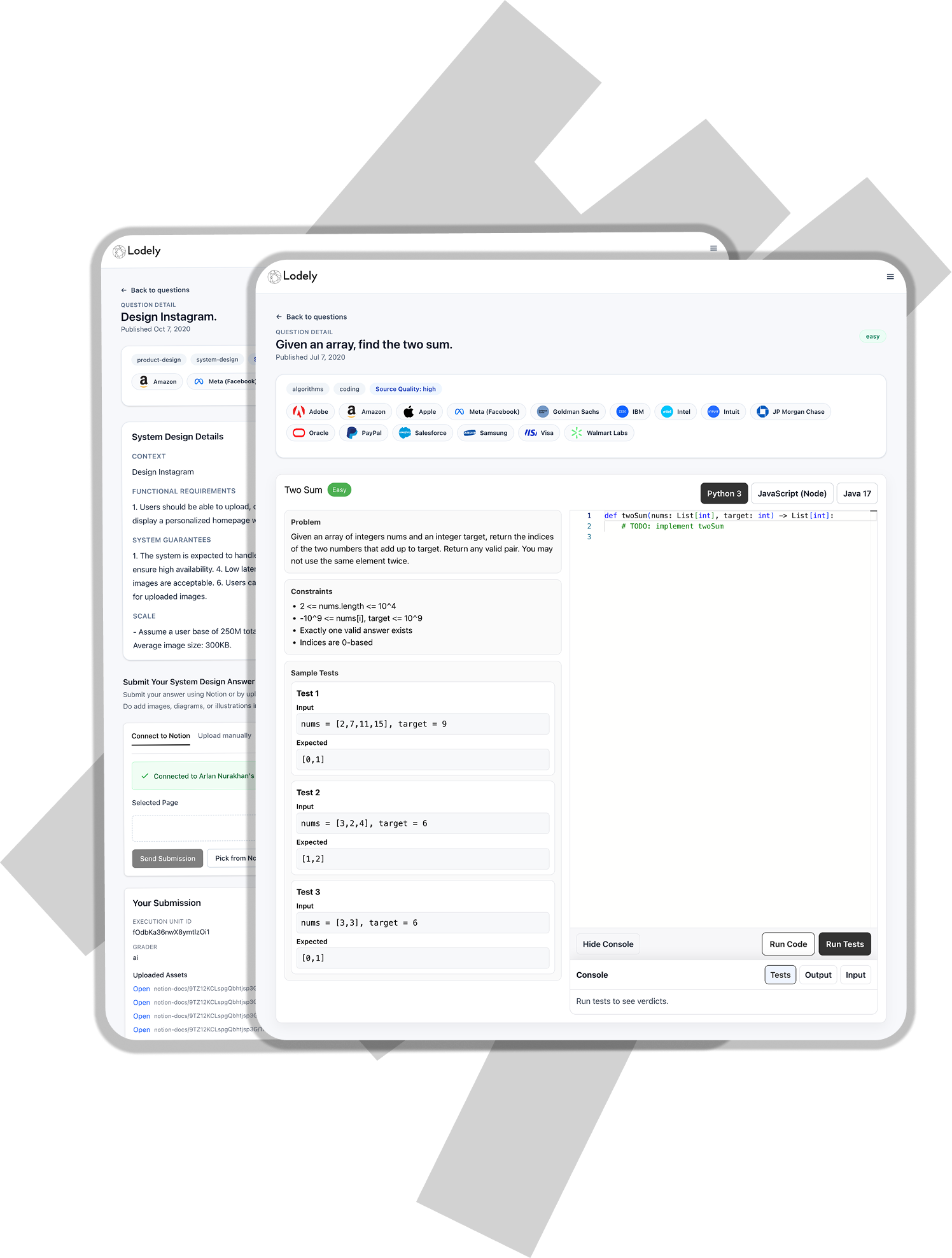
Use LeetCode, CodeSignal's own practice bank, or Codewars. Lodely structures these exact patterns into a guided prep path with company-specific filtering — so you're drilling what Uber, TikTok, and Robinhood actually test, not guessing from a generic bank. Don't just solve; review solutions and rewrite them from scratch the next day.
Step 4: Simulate real test conditions (Weeks 2-4)
Once weekly, sit down for 70 minutes and solve 4 problems — not timed separately, but as a real test. Use CodeSignal's practice environment. Track your time per question. See where you slow down.
Step 5: Learn fast debugging (Weeks 3-5)
Establish a 2-minute debugging checklist:
- Print input and expected output.
- Test edge cases manually (empty, one element, duplicates).
- Trace the logic on paper for a small example.
- Check off-by-one errors, null checks, type mismatches.
- Fix and resubmit.
This sounds trivial; it saves most candidates 10-15 minutes per test.
Step 6: Develop your test-day game plan (Final week)
Time allocation:
- Q1: 5-10 minutes. Solve cleanly, zero bugs.
- Q2 & Q3: 20-25 minutes each. Aim for a correct, reasonably efficient solution. If you hit a wall, leave a comment explaining your approach and move on.
- Q4: Whatever time remains (usually 15-25 minutes). If you have a good idea, pursue it. If not, write a brute-force solution with clear logic and move on.
Step 7: Control your test environment (Test day)
Quiet room, phone off, strong WiFi, second monitor (if allowed). Do 1-2 warm-up problems from the CodeSignal platform 30 minutes before. Get your mind in the zone. Expect proctoring to feel weird; normalize it beforehand.
Step 8: Retrospect & improve (Post-test)
Download your detailed feedback report. Identify weak areas: logic errors, time complexity misses, edge case failures. If you're below 425, drill that weakness for 2-3 weeks, then retake.
2026 GCA Prep Timeline
Here's a realistic 4-6 week schedule:
Week 1:
- Days 1-2: Learn format, watch walkthroughs, pick language.
- Days 3-7: Solve 10 easy and 5 medium problems. Focus on clean code, not speed.
Weeks 2-3:
- Build your 30-40 problem playlist across all categories.
- Solve 15-20 problems per week.
- One full 70-minute mock per week.
- Review solutions, rewrite them from scratch.
Weeks 4-5:
- Shift focus to speed and debugging.
- Two full 70-minute mocks per week.
- Stop learning new algorithms; drill speed on familiar patterns.
- Analyze your mock performance: where do you lose time?
Final week:
- Light review of weak categories.
- One full mock to ensure readiness.
- Practice your test-day environment setup.
- Rest the 2 days before your test.
Grading System
Scoring components: CodeSignal grades on correctness (how many test cases pass), efficiency (whether your solution scales to hidden datasets with larger inputs), and coverage (spreading your score across multiple problem types and edge cases prevents hard-coding).
How to Fix Your Score
If you landed below 425, here's the fix:
- Read your feedback report: CodeSignal breaks down failures by test case. Are you failing on correctness (logic bugs) or efficiency (time complexity)?
- Pinpoint weak areas: Graph problems? DP? String manipulation? Narrow it down.
- Drill that category: Solve 10-15 similar problems in 2-3 weeks.
- Practice under 70-minute pressure: Mocks are non-negotiable. Slow practice doesn't translate to fast test days.
- Master your debugging routine: Most retake failures are from careless mistakes that a 2-minute debug session would catch.
- Retake strategically: You have 2 retakes per 30 days. Space them 2-3 weeks apart to give time for improvement. Don't retake if you haven't drilled your weak spot.
Lodely builds structured prep paths that identify your specific gaps — not a content dump, but a guided sequence targeting exactly what tripped you up. That's faster than grinding randomly.
Industry Coding Framework vs GCA
GCA is narrow by design. Here's what it measures well:
- Algorithmic thinking under pressure: Can you solve a novel problem without hints or documentation?
- Breadth across data structures: Arrays, graphs, DP, greedy — you're tested on range.
- Baseline competence: The ability to write bug-free code in 70 minutes separates engineers from non-engineers.
Where GCA falls short:
- Code quality and readability: Submitted code is scanned for correctness, not style. Terrible variable names don't hurt your score.
- Team dynamics: Solo coding doesn't measure pair programming, communication, or code review skills.
- Real-world APIs: GCA is pure algorithms. You won't write a REST endpoint or interact with a database.
- Creative problem-solving: GCA rewards convergent thinking (finding the known solution), not divergent thinking (inventing new approaches).
Bridging the gap: Timed algorithmic practice + code refactoring + unit test writing + explaining your reasoning aloud + side projects that go beyond algorithms.
Which Companies Use CodeSignal GCA?
Major adopters:
- Uber, Instacart, Robinhood: Cornerstone of their hiring funnel.
- TikTok/ByteDance: Adopted GCA in 2025-2026.
- Zoom, Databricks, Brex: Use GCA for screening or filtering.
- Growing: Doordash, Figma, Stripe, Airbnb, Pinterest and dozens of mid-market tech companies.
Most of these companies have public minimum score thresholds (e.g., "450+ to advance to phone screen"). Score reusability is the hidden advantage: one strong test opens multiple doors.
Conclusion
In 2026, CodeSignal GCA is stricter, more generous with partial credit, and more widely used than ever. The 200-600 scale is tighter, so differentiation matters. Your prep should be systematic: learn the format, drill core problems, simulate test conditions weekly, develop a time-strategy, and control your environment. Aim for 475+. If you fall short, your feedback report is a diagnostic tool — use it to identify and fix exactly what broke. The retake limits mean you can't brute-force your way through; prep counts.
If you want a structured path instead of stitching together random resources, Lodely's prep guides break down exactly what to drill and in what order — tailored to the companies that use GCA. One strong score, multiple doors open.
✉️ Get free faang interview cheat sheet and interview tips weekly
✉️ Get free faang interview cheat sheet and interview tips weekly